
Writing is Thinking, but Better
If I can tell you to build one habit and one habit only, Writing would be it.

We’ve all heard the phrase, “write down your thoughts.” When we are getting confused, or thinking in many directions, it’s best to put our thoughts down on a paper. It gives us more clarity.
This is a first-order effect of writing, a direct impact.
But writing is more nuanced than that. It helps us in a lot of ways, many of them are not obvious. It unlocks a different style of thinking that just isn’t possible without it. I call this a second-order effect.
Let’s see how writing influences our thinking, directly and indirectly.
First-order effects
1. More clarity
Writing gives us more clarity. It’s good to write when we have many thoughts running in our heads. It provides clarity on all the ideas we are having. Instead of jumping from one to another in our head, we can look at all of them together written down.
When we are thinking about something, our brain loops around same things over and over. This is more apparent when we are anxious. It doesn’t help. We are not solving anything. But when we write, our brain stops the loop.
It knows the next step is taking an action.
2. Make things actionable
When you’ve written your thoughts down, you can see them together. They just got materialized. This makes the next step easier - the action.
When we are looking what had been going on in our heads, our mind begins to think “what do I do about it?” We are naturally wired to solve problems. When the constant loop stops, next obvious thing is the solution.
By just writing your thoughts down, you’ve made them solvable.
3. Communicate easily
It becomes easier to talk to people when you are clear on what you are working with. When you know what you trying to solve and what actions you can take, your conversations with your friends become easy. You are able to better communicate. And they are able to help you quickly.
It makes the conversation efficient.
Second-order effects
1. Opens second layer of cognition
When we write down our preliminary thoughts, we free up mental space. This gives space for secondary ideas to emerge.
When we think about an issue, it’s often not the fundamental problem we have. It’s rather a secondary or tertiary manifestation of an underlying problem. A basic problem that we want to solve.
As an example, when you are thinking about building a routine, it’s not that you want to have a routine for the sake of it. You want a routine so that you can work on things that are important to you. You don’t want to solve your routine-problem, you want to solve your priority-problem.
This realization will never occur if we only keep things in our heads, without diving deep or getting some clarity. When we free up the cognitive space, we unravel layers we didn’t think were there. The underlying reasons of our problems are different more often than not. Writing helps us figure those reasons out. This is called as First Principles Thinking.
2. Discover creative ideas
Free cognitive space allows new creative ideas to emerge.
Often the first few ideas we have are not the best ways to move forward. When we jump to take action on our first thought, we don’t give ourselves a chance to broaden our horizon.
In Product Management, there’s a dedicated step to ideate in Double Diamond approach. The goal is to come up with as many solutions as possible. They could be weird, out of proportion, outright stupid. But until you get several ideas on the table, you don’t move on to the next step. This process is called Explore.
Here’s how it looks like -
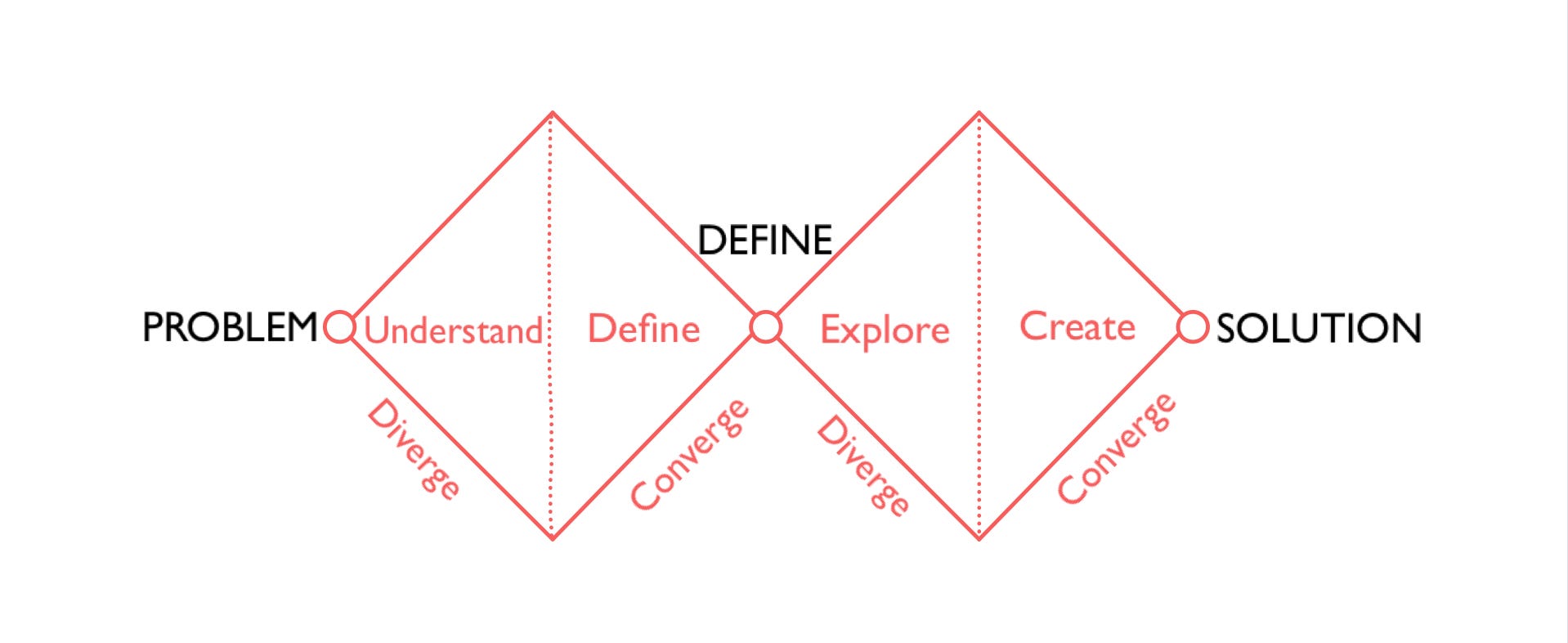
Brainstorming is encouraged in knowledge work. We need to do the same for our own ideas too. Better ideas emerge through this process.
3. Opens up an option for retrospection
When you’ve written things down, you can go back and see what your thought process was. It opens up the door to self-reflection.
I write Reflection Journal for the same reason.

Journalling is a good habit in itself. When done in this way, you are creating a timestamp. In future, you’ll be able to look at how you were making decisions before. It’ll be an opportunity to reflect, get some takeaways, and realize how far you’ve come.
I’m a big proponent of running your life in debug-mode. There’s no better way to improve than creating a feedback loop in life. All great systems have inherent feedback mechanism - that’s how Tesla drives itself. As John Maxwell have said, we don’t automatically gain experience and become wise. Rather it’s the evaluated experience that makes us better.
4. Become a better speaker
Writing makes you a better speaker. Any conversation you listen to, a podcast or a talk, notice how easy or difficult it is to pay attention throughout. You’ll see that good speakers are able to hold your attention much longer. They are good at storytelling, narration, and structuring their thoughts so it’s easy to grasp. Where does this ability come from? It’s writing.
All (almost) good speakers are writers. They know which words to remove that only add fluff. They know how to make an impact with right words. They understand how stories should be told. They understand how to keep their audience engaged. Part of the reason they have so much clarity is writing.
Writing and speaking are actually not that different. They both are mediums to convey our thoughts. Written words can be easily spoken. Speeches are translated universally. One is right next to the other.
Writing has lifelong affects. It’s a Keystone Habit. It helps you build more habits on top of it.
If I can tell you to build one habit and one habit only, this would be it.